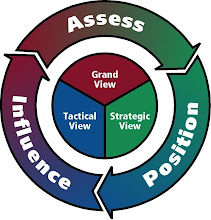
Consciously understand ["The Big Picture"] means watching the big picture from a ["cause and effect"] pov (from "macro to micro" start to finish) and ["not being in the picture"].
This approach allows the consummate game player to ["consciously view forward and review backward"] before releasing the trigger.
# # #
Wednesday, April 19, 2006 (SF Chronicle)
Air Force One data still on the Web/Once info posted,
it stays out there
Paul J. Caffera, Special to The Chronicle
A week after Pentagon officials ordered an Air Force
base in Georgia to remove from its Web site security
information about the two Air Force One aircraft,
the data remained publicly available Tuesday.
Officials at the Warner Robins Air Logistics Center
did not ignore the Pentagon command to remove the
information. In fact, within hours of the Air Force
chief of staff's office learning of the online posting,
Warner Robins authorities removed the technical order
that had caused consternation at the Pentagon and
White House.
The Air Force has discovered that once it -- or
for that matter anyone -- places a Web page on a
publicly accessible Internet site, that information
moves into the public domain.
"Once a page is out on the Net, Google and the Way
Back Machine make copies ... for long-term archive,"
said Internet security expert Steve Gibson,
president and founder of Gibson Research Corp.
Although the Air Force has attempted to put the
proverbial genie back into the bottle, Gibson said
the effort is all but a lost cause. Once something is
on a public Web site, "there is nothing, from a
technological standpoint, that can prevent anyone from
copying the information. There should be no expectation
that once published, that information can be
withdrawn."
Martin Libicki, an expert in information warfare
and security at Rand, was even more blunt.
Once government data is released onto the Internet, he
said, "it is gone."
The security information about Air Force One was
originally placed online in order to save a small
expense involved with creating and distributing CDs or
manuals for personnel who needed access to the
technical order.
The order described, among other things,
anti-missile defenses carried by Air Force One
that could be exploited by interests hostile to the
United States.
The disclosures went well beyond Air Force One.
The order, which was successfully cached online,
contained information about the countermeasures present
-- and absent -- on all U.S. and NATO military
aircraft. Much of this information was still
available online Tuesday.
Air Force and Pentagon officials scrambled
last week to remove the data after The Chronicle
reported April 8 that the information had been
posted on a public Web site.
David Ferguson, an Air Force data security official
at the Pentagon, acknowledged Tuesday the problems with
using the Internet to disseminate information not
intended for the general public.
"The Air Force has policy that says how (we) should
share information (but) we can't ensure people
read the policy. We do what we can to clean up
the mess afterward," Ferguson said.
In regard to people, such as bloggers, who copy and
disseminate publicly accessible data,
"legally there is not a lot we can do. ... We can
appeal to their patriotism."
---------------------------------------------------
Copyright 2006 SF Chronicle
---------------------------------------------------
http://www.sfgate.com/cgi-bin/article.cgi?file=/c/a/2006/04/19/MNG4OIBDBE1.DTL
---------------------------------------------------

Subscribe to:
Post Comments (Atom)
No comments:
Post a Comment