Favorite project management books are:
Code Complete (1994);
Rapid Development: Taming Software Schedules (1997);
Software Project Survival Guide (1998);
Professional Software Development (2004);
Art of Project Management (Scott Berkun); (2005) and
Software Estimation: Demystifying the Black Art (2006).
Favorite PM newsletters:
Bob Lewis's Advice line (infoworld) and Keep Joint Running (@ISSurvivor.com), Bob Lewis private newsletter;
Gantthead.com; and
Baseline.com.
Other recommended sites:
Stickyminds.com
As a project consultant, this Cardinal carries a customized library of templates.
In his library, the following categories of templates are:
* deliverables;
* project plans;
* presentation; and
* checklists.
@ some point of time, this Cardinal will make his customized library available for public viewing.
# # #
Project Manager: Strategist or Implementer?
Jacqueline Dasso Haddad, PMPJune 12, 2006
When selecting a project manager for your next project, should they be skilled in strategy definition or implementation? That same question has raised a debate within the project management community that has yet to be resolved. Managers tend to value a PM differently depending on how heavily they weigh a person working on "strategy" versus being responsible for implementation.
This article will explore the benefits of hiring the right skill set for a project manager so your next project will be a success.
Background
For several years now the project management profession has grown by people who pride themselves as being "strategists" and those who view themselves as being well trained or honed in project implementation.
Accountability
Defining strategy for a company can be challenging at best. Many times it begins with several people in a conference room spewing high level concepts and ideas that continually need refinement before momentum is gained and a clear vision has crystallized. Strong leadership skills are needed at this point in the project in order to keep the team on track, ensure group dynamics stay positive and work continues around a common goal.
Working on a "strategy project" drives limited accountability. "Limited" meaning the PM is responsible for defining the strategy but has no accountability if the project is successfully implemented.
Multiple functions and areas of a business must be utilized as input in order for a strategy to be ultimately successful. If a PM does not consider the business holistically and understand different groups' ability to support the proposed strategy, the project will quickly break down once implementation begins. Once a PM has worked at the tactical level of a project, they will know where/when the potential project pitfalls might occur and can plan accordingly.
Implementing a project ensures the PM is responsible throughout the project lifecycle and nothing can replace end-to-end accountability. "Strategy" definition is the envisioning phase. Project implementation focuses on all five stages of the project lifecycle. If the project is ultimately implemented successfully or not, the implementation PM is accountable to explain "why".
Return on Investment
When a project is successfully implemented, a true return on investment can be realized. This becomes especially important in today's environment as more companies rely on actual ROI before making a large investment.
I recently heard a co-worker state: "Anyone can cook this stuff up but if you can't implement it, it's not worth a darn." A strategy has no solid ROI, only projections based on assumptions. Actual returns are calculated once the project is implemented; a baseline is defined and can subsequently be measured year after year.
Who to Hire
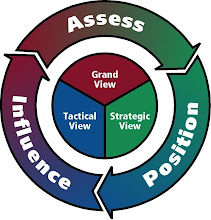
Balance is key in ultimately selecting a PM for your team. Ideally, a PM who can see "the big picture" is paramount in defining a strategy in order to move a group forward. That being said, they need to be able to think at a tactical level and implement the defined strategies before the business can truly realize any benefit or return on investment.
Next Steps
Where do you go from here? Who should you hire for your next project? Look at the objectives of what the business is trying to achieve. During the interview process, focus questions on how to get a better understanding of the types of projects and the timeframe when the PM came onto the project. It is not uncommon for a PM to be responsible for strategy definition in addition to implementation for the same project. Ultimately you should strive to find a PM who has a broad range of skills in both strategy definition and implementation (preferably on the same project). Once you have found that project manager, you have hit the jack pot!
Jacqueline D. Haddad, PMP was born and raised in Washington state. She received her undergraduate degree from Washington State University and graduate degree from Arizona State University. She most recently received her PMP certification in 2002. She currently resides in Sammamish, WA where she works as a Senior Project Manager. Her project management experience includes product development, launch and sustainment; business case definition; network design; business and system requirements; process development; testing and training. Her project experience also includes establishing and managing the Project Management Office for enterprise wide application implementations, customer strategy and business transformation planning.
Jacqueline D. Haddad, PMP was born and raised in Washington state. She received her undergraduate degree from Washington State University and graduate degree from Arizona State University. She most recently received her PMP certification in 2002. She currently resides in Sammamish, WA where she works as a Senior Project Manager. Her project management experience includes product development, launch and sustainment; business case definition; network design; business and system requirements; process development; testing and training. Her project experience also includes establishing and managing the Project Management Office for enterprise wide application implementations, customer strategy and business transformation planning.

No comments:
Post a Comment